Showing posts with label Erika Hennings. Show all posts

Friday, May 24, 2013

Five former DINA agents sentenced for the detention of MIR militant Alfonso Chanfreau Oyarce

Manuel Contreras Sepulveda, Miguel Krassnoff Martchenko, Marcelo Moren Brito, Ricardo Lawrence Mires were yesterday sentenced to ten years imprisonment for the detention and disappearance of MIR militant Alfonso Chanfreau Oyarce. Basclay Zapata Reyes was sentenced to three years' imprisonment for complicity in detention and torture while another indicted agent, Gerardo Urich Gonzales, was absolved.

Alfonso Chanfreau, a philosophy student and MIR militant, was detained on July 30, 1974. At approximately 11:30pm, a  number of agents surrounded Chanfreau's dwelling - orders came directly from Contreras. His wife; Erika Hennings, and their daughter were transferred to her parents' home. Chanfreau was taken to Londres 38 and tortured, in an attempt to garner information about other militants. Enraged by Chanfreau's silence, DINA agents detained Erika, taping her eyes shut as the vehicle passed the Mapocho river in order to render oblivious of her surroundings. She was transferred her to Londres 38 and tortured in the presence of her husband in order to force him to collaborate with the dictatorship.

Marcia Alejandra Merino, a former MIR militant turned collaborator, was instrumental in the detention and subsequent torture of Chanfreau. It is reported that while at Londres 38, Merino sought out Chanfreau, pleading forgiveness for his plight and stating that she had collaborated with DINA to avoid further torture. Luz Arce Sandoval, another militant turned collaborator whose testimony proved vital for the Rettig Commission, declared that she was forced to witness Chanfreau being tortured.

On December 17, 1974 ,the Interior Ministry gave orders regarding Erika Henning's exile, while denying that Chanfreau had ever been detained. Chanfreau's name later appeared on the list of the 119, also known as Operacion Colombo - one of the dictatorship's fabrication of memory in which it was claimed that certain MIR and Communist Party militants had died as a result of infighting while abroad.

Testimony from witnesses indicate that Chanfreau was intensely tortured, as DINA believed he had access to fundamental information which would aid them in the destruction of MIR.

As in other cases, justice continues to be seriously hampered owing to impunity laws. The former agents will serve their sentences in Penal Cordillera, described by many as a luxurious five start dwelling, while dictatorship survivors and relatives of the desaparecidos remain entrenched within a fragment of mangled memory which is temporarily alleviated by judicial sentences long due. Former agents still retain their oath of silence about the the systematic disappearance of detainees, which makes a further recovery of memory an improbable accomplishment.

Sunday, August 12, 2012

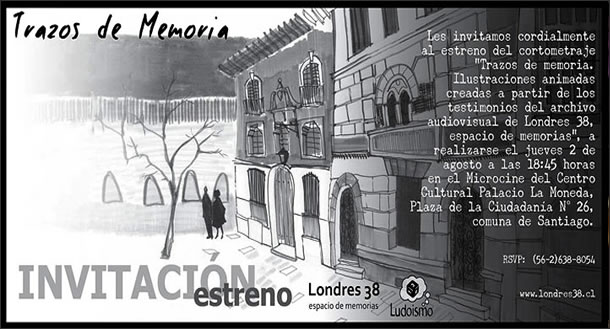
Trazos de Memoria

Trazos de Memoria
Illustraciones animadas creadas a partir de los testimonios del archivio audiovisual de Londres 38, espacio de memorias
Londres 38, 2012.


Trazos de Memoria seeks to re-enact the recent history of Chile's dictatorship and its widespread torture and macabre annihilation of opponents. A short, illustrated text with testimonies from torture survivors and relatives of detenidos desaparecidos, the book imparts a sliver of memory narrative in flashes of recollections.

The testimonies are taken from Londres 38's audiovisual archive. Guillermo Rodriguez Morales (former MIR militant), Miguel Angel Rebolledo (former MIR militant), Mario Irarrazabal (survivor of Londres 38), Erika Hennings (former MIR militant, survivor of Londres 38 and wife of detenido desaparecido Alfonso Chanfreau), Luz Encina Silva (human rights activist and mother of detenido desaparecido Mauricio Jorquera Encina, former MIR militant) and Gastón Muñoz Briones (former MIR militant and torture survivor) disclose their experience of dictatorship practices, notably the struggle of each individual against the uncertainty of their plight.

As this book shows, the struggle against oblivion was a collective commencing far before Pinochet's insistence to obliterate memory with regard to torture and disappearances. Resisting lies regarding detention, blindfolds and unknown destinations, detainees relied on memory and verbal communication to construct their narratives and identity within history, in order to ensure recognition of other torture victims whose disappearance remains shrouded in violence and oblivion. A very striking testimony by Erika Hennings describes the manner in which detainees would describe themselves to others incarcerated with them - one of the women participating in this exercise was Muriel Dockendorff Navarrete, a disappeared former MIR militant whose name appears in the List of the 119, or Operacion Colombo.

The book is free to download from Londres 38 espacio de memorias. An innovative manner of imparting memory, I highly recommend this book for anyone willing to join the fight against dictatorship oblivion; also for others whose journey through history and memory needs to be rekindled.

Neither forgiveness, nor oblivion. A steadfast struggle for justice within memory.

Wednesday, May 9, 2012

The Right to Memory in Chile: An Interview with Erika Hennings, President of Londres 38

This article was first published in Upside Down World here 

Operacion Colombo, or the case of the 119[1] was an intelligence operation staged by DINA (Dirección de Inteligencia Nacional), which sought to exterminate political opponents of Pinochet’s dictatorship. Most of the victims were members of MIR. Having first been detained in Londres 38[2], most of the detained persons were ‘disappeared’[3] by DINA. In what amounted to a treacherous conspiracy, Pinochet’s dictatorship allied itself with other repressive governments in Latin America, seeking to influence public opinion about the fate of the desaparecidos by publishing articles about supposed political turbulence within the left which led MIR members to turn against each other.

In memory of the desaparecidos, as well as an assertion in favor of the right to memory, Londres 38: Espacio de Memorias inaugurated an exhibition detailing the origins and set up of Operacion Colombo. Erika Hennings, President of Londres 38, speaks about the right to memory – a contrast with state laws and dictatorship practices which act as censorship or criminalization of social mobilization in Chilean society.

Ramona Wadi: Explain the historical connection between Operacion Colombo and Londres 38.
Erika Hennings:
The victims of Operacion Colombo are all people arrested by DINA, whose systematic method of disappearance started in Londres 38. That location was a place of detention, torture and extermination of people, mostly leftist militants during that particular period of MIR. DINA devoted itself primarily to the extermination of MIR (Movimiento Izquierda Revolucionaria). Besides the missing victims there are innumerable persons who survived their detention in Londres 38, and were witnesses of the detention and missing of people who are in the 119 list, and therefore are also witnesses of the farce and set-up which was realized to conceal the facts.

RW: What was the dictatorship’s aim in orchestrating Operacion Colombo? How did other governments in Latin America collaborate with DINA’s manipulation of events?

EH: Operacion Colombo was staged by the repression of the dictatorship, together with its intelligence agency, DINA, to conceal their crimes, most of which still remain unpunished. Operacion Colombo was part of Operacion Condor, which coordinated the repressive apparatus of the Southern Cone together with the participation of agency officials such as embassies and news media. With the repressive Argentine intelligence and complicity of the Chilean press, such as El Mercurio, La Segunda and La Tercera, the dictatorship found a way to sway public opinion with regard to the desaparecidos, attributing their deaths to internal leftist political strife, especially with regard to MIR. In this context, the Chilean press reports reproduced information published in journals: Lea in Argentina and Novo O Díain Argentina and Brazil, which ‘clarified’ the whereabouts and circumstances of the 119 persons. The first of these publications reported about the fate of 60 desaparecidos, while the others reported about the remaining 59.

RW: Has any information resurfaced about the fate of the victims? Can you relate the stories of any of the desaparecidos?

EH: In the case of persons disappeared by DINA, the 119 and the other hundreds of desaparecidos, there has never been any confirmed information relating to their fate.

RW: What does the exhibition attempt to convey and how does it challenge current laws and impunity in Chile?

EH: The exhibition “Montajes Comunicacionales del pasado y el presente” arises out of a need to visualise the operations conducted by the dictatorship to hide their crimes, most of which still remain unpunished due to impunity.

The Courts of Justice are still investigating the case of Operacion Colombo; family members and human rights agencies hold a firm conviction that permanent struggle and determination can support the achievement of justice. Some condemnations have been achieved in a few cases of the desaparecidos, however sentences have not been harsh and many cases still fall under the impunity.

At the same time it is necessary not only to achieve permanent mobilization against cases in the recent past, but also towards present cases which are a continuity of practices from the dictatorship. State security law and the anti terrorist law are being used to criminalize all social mobilization.

RW:
How did the idea for the exhibition originate? Describe the exhibition and what it seeks to portray through the various mediums used.

EH: Londres 38, Espacio de Memorias, raises the significance of memory that links them to the present, in order to release knowledge that may lead to reflection and action on what is occurring today, which should generate a contribution to legal and social justice, as well as respect for human rights in its broadest perception.

This exhibition traces the origins of Operacion Colombo. Panels portray the origin of Operacion Colombo, its context and its relationship to other frame ups such as Operacion Salamandra, also known as El Caso Bombas. The exhibition also includes life size silhouettes of the missing 119 detainees, whose detention and attempted murder was denied by those orchestrating Operacion Colombo.

RW: What effect does this exhibition have on memory and citizenship and how does it establish a link between relatives of the desaparecidos and the public?

EH:
I can’t say what effect this exhibition had, but the wide participation of the citizens in this effort meets the goal of imparting knowledge about what happened and delivers elements which make it possible for people to reflect on how impunity allows the continuity and repetition of facts to silence all social and political mobilization. The relatives of the desaparecidos are part of the ‘public’, part of the citizens – they are informed and mobilized.

RW: Has the exhibition compelled people to come forward with any information relating to Operacion Colombo or other dictatorship related torture?

EH: The people approach, discuss, they comment with regard to the exhibition, they wonder and question. There is a perceived great interest to discover and link with other cases of frame ups which they have known or heard of.

RW: How does the exhibition challenge Chilean media and is there any repetitive pattern in media manipulation from the dictatorship era?

EH: A leading role was played by the press addicted to the dictatorship. Chile’s media and journalists from the media provided space in their pages to try to give credibility to the lie known as Operacion Colombo. More than 30 years later, media such as La Segunda, El Mercurio and La Tercera have never given an explanation about their lies and complicity with these crimes. They enjoy total impunity. It is this impunity that allows more than 30 years later, journalistic practices which are complicit in political, economic, religious, the police and any other kind of power. Empowered by the same impunity, the media which in the past participated in Operacion Colombo now echo, without ever questioning police versions, or else in collusion with government prosecutors, the cases which affect the Mapuche people or young anarchists.

The Patriot Act, the law of state security and the press have been used in these years of democracy as means to criminalize social movements and struggles. More recently, the prosecution was unable to sustain terrorism charges against young anarchists whilst the media had already condemned them.

RW: How much would you say the right to memory is respected in Chile, and can you speak about any contrasts between Chilean civilians opposing the dictatorship and the government, with respect to the right to memory?

EH: The exhibition “Montajes comunicacionales del pasado y el presente” was scheduled to be launched in January this year at the Library of Santiago, but the entity attempted to modify the contents of the exhibition – an act of censorship that was rejected by Londres 38, Espacio de Memorias.

For Londres 38, Espacio de Memorias, modifying the contents of the exhibition by a public body not only violated editorial principles but also, the attempt at censorship contradicted the principles of the International Federation of Library Associations and Institutions (IFLA) and specifically, those posed by its Committee of freedom of expression and access to information, which states that libraries contribute to the development and maintenance of intellectual freedom and help safeguard basic democratic values and universal civil rights. Furthermore, it states that libraries should acquire, organize and disseminate information freely and oppose any form of censorship. Also libraries should preserve and make available the widest variety of materials reflecting the plurality and diversity of society, providing users with the ability to communicate and express themselves; which should not be censored or restricted by policy approaches.

In this sense, Londres 38, Espacio de Memorias, defends its right to maintain and preserve its editorial policy, where the contents of memory retrieval are a necessity related to the present. Similarly, Londres 38 states that the state has the obligation to guarantee the right to memory; it should ensure the plural use of public spaces for citizens’ organizations. After a meeting with the Director of the Dibam (Dirección de Bibliotecas, Archivos y Museos), on whom the library of Santiago depends, it was decided that the exhibition would be displayed on the site as originally designed by Londres 38, Espacio de Memorias.

For now the show will remain in Londres 38 until April 25. Immediately after that date, the exhibition will be visiting various facilities of the Universities of Chile and Catholic Universities – organized by their respective student federations - municipalities such as La Granja, San Miguel and San Joaquin, as well as library spaces of independent publishers such as GAM and Museo de la Memoria.


Ramona Wadi is a freelance writer living in Malta. Visit her blog here.

Notes: