Showing posts with label MIR Chile. Show all posts

Friday, December 27, 2013

El despertar de los cuervos. Tejas Verdes, el origen del exterminio en Chile

El Despertar De Los Cuervos Tejas Verdes. El Origen Del Exterminio En
Following the macabre narration ‘La Danza de los Cuervos: el destino final de los detenidos desaparecidos’, which describes the torture and extermination of dictatorship opponents carried out in Cuartel Simon Bolivar, Javier Rebolledo’s latest book, ‘El despertar de los Cuervos. Tejas Verdes, el origen del exterminio en Chile’ (Ceibo Ediciones, 2013) provides a detailed account of DINA’s formation in Tejas Verdes – the location where experimentation with torture was carried out in the early days of the dictatorship.

 
The prologue to the book describes perversity as an inadequate term in relation to dictatorship atrocities committed in Chile. With the full truth of horrors still concealed from the nation, the subject of torture, extermination and disappearance is shrouded within various levels of anonymity – the anonymity enforced by DINA upon the disappeared, torturers whose identity is still undisclosed, and tortured victims who are reluctant to disclose their accounts and add to the Chilean collective memory framework.
Alternating between testimonies from torture survivors, information from official investigation documents and critical commentary, Rebolledo’s account of Tejas Verdes validates his earlier statement dwelling on the difference between conventional reporting about atrocities and survivor testimony. The dehumanisation of detainees through various forms of torture, degradation, manipulation of culture and a refusal to acknowledge individual identity of detainees created harrowing narratives vacillating between the need for recognition and the experiences which DINA attempted to mire within a widespread imposition of oblivion in order to consolidate impunity.
The importance of Tejas Verdes has been overshadowed by other infamous torture centres such as Londres 38 and Villa Grimaldi, as well as by operations carried out by DINA involving the extermination of MIR and Communist Party militants such as the Caravan of Death and Operacion Colombo. However, prior to the formal establishment of DINA, political opponents of Augusto Pinochet were already being tortured and disappeared from Tejas Verdes – the primary torture and extermination centre in Chilean dictatorship history.
Tejas Verdes served as the initiation into torture and a focal point for other torture and extermination centres in Chile. The majority of torturers received their instruction at Tejas Verdes – names such as Marcelo Moren Brito, Miguel Krassnoff Martchenko, Ricardo Lawrence and Cristian Labbé featuring prominently in dictatorship history. Operating under various brigades, DINA agents were tasked with intelligence operations, specific targeting of MIR and Communist Party militants, security and clandestine operations involving extermination of dictatorship opponents. Of particular mention are Brito’s role in the Caravan of Death and Krassnoff’s torture practices in Londres 38. Brigada Halcón, which operated in Londres 38, was also involved in the kidnapping, torture and murder of Víctor Díaz which occurred at Cuartel Simon Bolivar. The refinement of torture practiced in other torture centres such as Clínica Santa Lucia – an issue discussed by Patricio Bustos Streeter indicates a continuous attempt to obliterate any previous errors and cultivate an elaborate impunity. Rebolledo also discusses the existence of Brigada Mulchén under the command of Cristian Labbé – a relatively unknown brigade involved in clandestine operations but whose complicity has been difficult to prove, apart from the murder of Spanish diplomat Carmelo Soria in 1976.
Rebolledo shows how, despite judicial investigations initiated by Judge Alejandro Solis, it has been impossible to determine the number of detainees held in Tejas Verdes. What emerged, however, were the details of an appalling torture network headed by Manuel Contreras Sepulveda – a testimony of sadism in the name of eradicating Marxism from Chile. Torturers indicted by Judge Solis portrayed themselves as patriots unjustly accused, who had allegedly saved Chile from the grips of a communist dictatorship. Through the exhibited vestiges of dictatorial power during the trials of former DINA agents, such as Contreras’ threats to Judge Solis, it is possible to discern the traits of an organisation which operated with impunity.
The testimonies of Anatolio Zarate, Ana Becerra, Olga Letelier and Feliciano Cerda, supplemented by other narrations garnered from official investigation documents, portray the extent of human rights violations which DINA agents indulged in. The torture sessions were designed to create a barrier of immense magnitude between torturer and detainee, between detainee and humanity. Torture survivors describe electric shocks through use of the parilla, sexual violence and coercion, severe beatings, mock executions, the insertion of mice and spiders in the vagina, genital mutilation, use of dogs in sexual torture, mutilation, amputations and crude cauterisation, violation in the presence of family members, degrading language, as well as forced ingestion of urine and faeces. Pleas for death on behalf of detainees were met with additional bouts of torment.
Former soldiers who testified against Contreras claimed that detainees were lured to Tejas Verdes upon the premise of ‘discussing’ points of contention, which was imparted in an official letter. Prospective detainees usually complied and exhibited no resistance, discovering upon arrival the nature of DINA’s alleged discussion. Some were assassinated upon the fabricated pretext of attempting escape, others who voiced their fears of being murdered, such as detainee Lucho Normabuena, were systematically disappeared. Medical professionals who attempted to inscribe the truth about the cause of death were detained in Tejas Verdes. Detainees were forced to listen or witness their friends being tortured, while DINA embarked upon plans in the hope of extracting information from detainees upon other detained militants. Olga Letelier describes how torture sessions were usually attended by a group of DINA officers, alternating between watching and participating in torture.
The book also expounds upon the network of health care professionals recruited to supervise torture and instruct DINA torturers in recognising individual thresholds to reduce the possibility of murder during a torture session. With most medical torturers still benefiting from impunity, Chilean society has to contend with yet another contradiction – that of entrusting their health to doctors whose complicity in torture and murder is still concealed. A list of former medical torturers still practicing their profession has been circulating on the internet, in a bid to expose further DINA atrocities. The literature dealing with medical torturers in the book explicitly portrays how the dictatorship disfigured the profession. Among others, Rebolledo’s book refers to Vittorio Orvieto Tiplisky, who commenced his career with DINA at Tejas Verdes and later participated in the extermination of militants at Cuartel Simon Bolivar; nurse Gladys Calerdon who administered lethal injections to tortured detainees prior to their disappearance and Roberto Lailhacar, who recently admitted to the disposal of six disappeared dictatorship opponents in wells on his property at Curacaví.
Rebolledo has bequeathed another significant treatise to Chile’s recent history. It affirms a previous statement by Chilean author and survivor of Tejas Verdes, Hernan Valdes, who summarised Tejas Verdes thus: “All I knew about evil until then was only caricature, only literature. Now evil has lost all moral reference.” Pinochet’s plea for oblivion decades later served as a reminder of what leftist opposition had struggled against. Oblivion had already been implemented by the dictatorship prior to any public call, as evidenced from the early disappearances from Tejas Verdes, the certainty of impunity which was flaunted time and again at tortured detainees, the illegal adoptions of babies born to detainees in order to eliminate traces of rape in detention centres, the medical practitioners who worked under assumed names, thus separating their roles as torturers from the role assumed within the wider berths of society. The detailed testimony and commentary in this book prove that Tejas Verdes should be at the helm of any detailed research regarding Pinochet’s dictatorship – it is through an understanding of Tejas Verdes as the primary reference to human rights violation that one can comprehend the extended torture network and state complicity during the Chilean dictatorship.

Friday, May 24, 2013

Five former DINA agents sentenced for the detention of MIR militant Alfonso Chanfreau Oyarce

Manuel Contreras Sepulveda, Miguel Krassnoff Martchenko, Marcelo Moren Brito, Ricardo Lawrence Mires were yesterday sentenced to ten years imprisonment for the detention and disappearance of MIR militant Alfonso Chanfreau Oyarce. Basclay Zapata Reyes was sentenced to three years' imprisonment for complicity in detention and torture while another indicted agent, Gerardo Urich Gonzales, was absolved.

Alfonso Chanfreau, a philosophy student and MIR militant, was detained on July 30, 1974. At approximately 11:30pm, a  number of agents surrounded Chanfreau's dwelling - orders came directly from Contreras. His wife; Erika Hennings, and their daughter were transferred to her parents' home. Chanfreau was taken to Londres 38 and tortured, in an attempt to garner information about other militants. Enraged by Chanfreau's silence, DINA agents detained Erika, taping her eyes shut as the vehicle passed the Mapocho river in order to render oblivious of her surroundings. She was transferred her to Londres 38 and tortured in the presence of her husband in order to force him to collaborate with the dictatorship.

Marcia Alejandra Merino, a former MIR militant turned collaborator, was instrumental in the detention and subsequent torture of Chanfreau. It is reported that while at Londres 38, Merino sought out Chanfreau, pleading forgiveness for his plight and stating that she had collaborated with DINA to avoid further torture. Luz Arce Sandoval, another militant turned collaborator whose testimony proved vital for the Rettig Commission, declared that she was forced to witness Chanfreau being tortured.

On December 17, 1974 ,the Interior Ministry gave orders regarding Erika Henning's exile, while denying that Chanfreau had ever been detained. Chanfreau's name later appeared on the list of the 119, also known as Operacion Colombo - one of the dictatorship's fabrication of memory in which it was claimed that certain MIR and Communist Party militants had died as a result of infighting while abroad.

Testimony from witnesses indicate that Chanfreau was intensely tortured, as DINA believed he had access to fundamental information which would aid them in the destruction of MIR.

As in other cases, justice continues to be seriously hampered owing to impunity laws. The former agents will serve their sentences in Penal Cordillera, described by many as a luxurious five start dwelling, while dictatorship survivors and relatives of the desaparecidos remain entrenched within a fragment of mangled memory which is temporarily alleviated by judicial sentences long due. Former agents still retain their oath of silence about the the systematic disappearance of detainees, which makes a further recovery of memory an improbable accomplishment.

Sunday, May 12, 2013

Additional prison sentence for former DINA agent Miguel Krassnoff Martchenko

Miguel Krassnoff Martchenko
The Santiago Court of Appeals has sentenced former DINA agent Miguel Krassnoff Martchenko to 541 days in prison for the torture of MIR militant Guacolda Rojas Pizarro during her detention at Villa Grimaldi.

Krassnoff, who is already serving a 144 year prison sentence for his role in torture and disappearance of leftist militants and sympathisers, has been condemned by Judge Mario Carroza for subjecting Rojas to beatings, various forms of sexual torture and applying electric current to sensitive parts of the detainee's body. Rojas was later transferred to Tres Alamos and Cuatro Alamos, finally being released from her ordeal.

In a previous conviction for torture and disappearance of Maria Cecilia Labrin Saso, Krassnoff sought to reinvent his image of notorious torturer who never bothered to shield his identity from detainees, into that of a researcher employed to study the dynamics of 'terrorist groups like MIR'.

Human rights supporters and groups concerned with furthering the struggle for memory in Chile do not deem the judicial ruling as particularly effective, considering the luxurious incarceration epitomised by the Penal Cordillera - a military building bequeathed to Augusto Pinochet's convicted agents. Apart from the privileged surroundings, including the use of lavish recreations areas, the torturers have also been entitled to benefits and pensions depending upon their rank during the dictatorship.

Chile's right wing, however, still hails Krassnoff as 'innocent' and patriotic. Gabriela Silva Encina's book 'Miguel Krassnoff: Preso por Servir a Chile' (Miguel Krassnoff: Incarcerated for serving Chile) remains touted as a knowledgeable treatise amongst neoliberal circles, despite the fact that the historian denies any human rights violation during Pinochet's dictatorship.

Saturday, December 29, 2012

La danza de los cuervos: el destino final de los detenidos desaparecidos

La Danza de los Cuervos: el destino final de los detenidos desaparecidos
Javier Rebolledo
Ceibo Ediciones, 2012

The history of Cuartel Simón Bolívar remained a heavily shrouded secret of Direccion de Intelligencia Nacional (DINA), until the pact of silence was broken by Jorgelino Vergara Bravo, known as ‘el Mocito’. A struggle for survival grotesquely transformed into a life of treason – a man of campesino origins working as a servant in the household of Manuel Contreras Sepulveda – Head of DINA, later progressing to inclusion in DINA and transferred to Cuartel Simón Bolívar. ‘La Danza de los Cuervos: el destino final de los detenidos desaparecidos’ (Dance of Crows: the fate of the disappeared detainees) delves into the atrocities committed by Brigada Lautaro and Grupo Delfín through Vergara’s testimony who, in 2007, declared the Cuartel as ‘the only place where no one got out alive’.  Residents living close to the extermination centre were reluctant to make friends, out of mistrust and the uncomfortable proximity to the terror inflicted upon detainees.
Vergara’s initiation into Manuel Contreras’ realm started with his employment as an errand boy. During the months spent at the household, Vergara equated respect with authority, particularly manifested in his obsession with weapon handling and ownership and learning to work in relation to crime, albeit unconsciously at first. Contreras’ power was gradually revealed – occasional phone calls from dictator Augusto Pinochet, the arrival of Uruguayan President Juan María Bordaberry and the ensuing collaboration in staging Operación Condór and Operación Colombo, the expensive automobiles, the presence of bodyguards and the visits of other DINA agents, such as Miguel Krassnoff Martchenko, Michael Townley and Juan Morales Salgado, were a fragment of the reality incarcerated within Cuartel Simón Bolívar.
Javier Rebolledo portrays Vergara’s testimony as a narration of memories, prompted by the author at times for clarification or further information; supplemented by the author’s research through official documents and court statements. However, it is essentially Vergara’s history intertwined with that of the torturers and the desaparecidos of Cuartel Simón Bolívar. Apart from his insistence that he was never involved in killing or torturing any of the desaparecidos, the sensation of blame is effortlessly enhanced. Indeed, Judge Victor Montiglio only acquitted Vergara on the grounds that he was not yet an adult according to the law, during his tenure working for DINA’s Brigada Lautaro and Grupo Delfín.
The initial realisation of betrayal is only intensified as the book progresses. Vergara’s betrayal of his campesino origins, his betrayal of DINA and, more importantly, the betrayal of Chile’s struggle against oblivion merge and distance themselves incessantly. The contrasts of relieving one’s conscience versus the convenience of acquittal, coupled with Vergara’s trepidation of a possible assassination for revealing DINA’s profoundly fortified secret, all point to complicity in the fate of MIR and Partido Comunista disappeared militants.
On January 20, 2007 Jorgelino Vergara Bravo broke the pact of silence after being falsely identified as the murderer of Víctor Manuel Díaz López, head of the clandestine organisation of Chile’s Communist Party. Insisting that he never killed or tortured any of the desaparecidos, Vergara’s testimony shed light on Cuartel Simón Bolívar as Chile’s torture and extermination centre. There had been numerous speculations about the existence of a site specifically used for the persecution, torture and annihilation of MIR and Communist Party Militants, but DINA refused to reveal any vital information. While Vergara was detained in a high security prison, 74 DINA agents were immediately arrested, leaving no chance for a possible corroboration between officials to avail themselves of impunity. Betrayals and denials ensued. Contreras denied ever having set eyes upon Vergara. On the contrary, Juan Morales Salgado, Head of Brigada Lautaro, was the first to affirm that Vergara ‘was neither an apparition nor paranoid’, confirming Vergara’s employment at Cuartel Simón Bolívar and his previous job as errand boy in Contreras’ household.
Montiglio’s perseverance in bringing the DINA agents to justice was abruptly terminated upon his demise from cancer in 2011. By that time, evidence about Cuartel Simón Bolívar, the Calle Conferencia cases, as well as the process of disappearing MIR and Communist Party militants and Operacion Retiro de Televisores was swiftly unravelling, revealing the ruthless mechanisms of Brigada Lautaro and Grupo Delfín.
Vergara’s previous fragmented knowledge, garnered from conversations between Contreras and other DINA agents, including Miguel Krassnoff Martchenko, Juan Morales Salgado, Burgos de Beer and Moren Brito, gradually manifested itself into revelations of actual torture and extermination ritual. Serving coffee and sandwiches to agents in the midst of torture sessions, Vergara recalls the indifference with which instructions on how to serve coffee jarred with the sight of a detainee writhing from excruciating torture. However, these scenes portrayed a fragment of the torture process. Vergara’s recollections of Dr Osvaldo Pincetti (also known as Dr Tormento) and detainees were impregnated with detail, yet the fate of the tortured dissidents remained obscured. Dr Pincetti specialised in hypnosis; on one occasion Vergara witnessed a victim being forced to watch himself bleed to death – a form of torture designed to coerce the dissident into signing false confessions or supplying information about Chilean dissidents.
The severity of torture ensured that detainees were exterminated and disappeared within seven days of arriving at Cuartel Simón Bolívar. Detainees were forced to listen to their compañeros’ anguish during torture sessions involving the parilla, which administered electric shocks to sensitive parts of the body, including the genitals. Sometimes detainees were beaten to death or asphyxiated. Nurse Gladys Calderon, another DINA recruit whose work experience included assisting Dr Vittorio Orvietto Tiplizky in Villa Grimaldi and DINA agent Ingrid Olderock, notoriously renowned for training dogs to violate women, administered cyanide injections to all detainees. Questioned about her role, Calderon deemed it ‘an act of humanity’ which ended the suffering of those destined to become the desaparecidos of Cuartel Simón Bolívar.
Vergara also narrates how detainees were used to test the manufacture of chemical weapons. Developed and manufactured by Eugenio Berriós and Michael Townley; a US citizen recruited by DINA and now living under the witness protection programme in the US, sarin gas featured prominently in Cuartel Simón Bolívar. Two Peruvian men were detained and brought to the Cuartel, where they were forced to inhale sarin gas in the presence of Contreras, Salgado, Barriga, Lawrence and Calderon. The Peruvians were administered electric shocks using a new device displayed by Townley and later beaten to death. Their bodies were probably disposed of in Cuesta Barriga – the site in question during the illegal exhumation of the desaparecidos’ bodies during Operación Retiro de Televisores in 1979.
 

Reinalda Pereira
Víctor Díaz
Memories of the torture inflicted upon Daniel Palma, Víctor Díaz, Reinalda Pereira and Fernando Ortiz Letelier are narrated in detail by Vergara, who describes Palma’s cries as being the loudest ever heard, prompting DINA agents to increase the sound level of their stereos to obliterate his cries. Díaz was tortured on the parilla, asphyxiated and later administered a cyanide injection by Calderon, upon direct orders from Morales. After manifesting her terror at the inability to protect her unborn child, Pereira was subjected to mock executions and severe beatings, incited by her pleas to DINA agents to kill her. Ortiz was beaten to death. The bodies were later subjected to further degradation – agents pulled out the teeth in a search for gold fillings. Later, the faces, fingers and any other particular features were torched to prevent any possible identification. As with other Calle Conferencia victims, the bodies of the detainees were ‘packaged’ during the night and ushered out of Cuartel Simón Bolívar, destined for burial in Cuesta Barriga or transferred to Pedelhue, loaded upon helicopters and dumped into the sea. According to Vergara, the desaparecidos were deemed ‘fodder for the fish’ by DINA agents. In 1976, 80 MIR militants suffered the fate of the detenidos desaparecidos – most of them through Cuartel Simón Bolívar.
Daniel Palma
Fernando Ortiz Letelier
Rebolledo’s intricate research constructs the alliance between agents of Cuartel Simón Bolívar and other detention and torture centres. A number of agents forming part of Brigada Lautaro and Grupo Delfín were part of the contingent from Tejas Verdes. As the persecution of MIR and Partido Comunista militants widened to encompass all of Chile, torture centres were set up around the country under the command of Manuel Contreras. At the time of Vergara’s inclusion in DINA, torture centres such as Villa Grimaldi, Londres 38, Tres y Cuatro Álamos and José Domingo Cañas were already operating under special brigades such as Brigada Halcón, headed by Miguel Krassnoff Martchenko and responsible for the torture of detainees at Londres 38.
 
Vergara recalls a visit to Colonia Dignidad, run by Paul Schäfer and notorious for its abuse against incarcerated minors. Rumours originating from Contreras’ bodyguards indicated that DINA agents profited from the desaparecidos by setting up an organ trafficking trade to Europe, with the recipient countries being Switzerland and Belgium.
 
Betrayals ensured within DINA following its disintegration after the assassination of Orlando Letelier. With the creation of the CNI, Vergara was transferred to Cuartel Loyola where he found himself lacking the imaginary protection offered by Contreras. Pressed by Rebolledo as to whether he participated in any assassinations after his stint at DINA, Vergara replies in a rhetorical manner, implying self-defence against aggression as implication of participation. Rebolledo remarks upon the vagueness of Vergara’s recollections in this period, noting once again that Montiglio had exonerated him solely because he had been a minor during his time at Cuartel Simón Bolívar. The vague recollections coincide with Operacion Retiro de Televisores – an encrypted message issued by Pinochet ordering agents to illegally exhume the remains of the bodies buried clandestinely in Cuesta Barriga. The remains were either dumped into the sea or burned, to avoid any official investigation. Bone fragments later discovered on site led to the identification of Fernando Ortiz Letelier, Ángel Gabriel Guerrero, Horacio Cepeda and Lincoyán Berríos – all victims of Calle Conferencia.
 
The book is punctuated with the contrast between the lives of the desaparecidos and the agents in charge of their extermination, laying bare the crudeness with which various sections of the Cuartel served for disparate purposes – desaparecidos left to bleed to death in the gym, which would later be cleaned and used by the agents for their physical training. Sporting events were also held between different brigades of various torture centres.
 
Undoubtedly, Rebolledo’s research is striving to shift the dynamics of impunity. Recently the author was subjected to acts of intimidation when his research detailing further DINA atrocities was stolen. Chile’s dictatorship disguised under a semblance of democracy is still resisting the masses’ struggle in favour of memory.  As stated in the first chapters, various agents still have not been processed for their roles in dictatorship crimes, whilst others continue to wield influence in Chile’s legal and political hierarchy.
‘La danza de los cuervos’ is both an indispensable read and a significant contribution to Chile’s struggle against oblivion and impunity. The exploitation of humanity decreed by Pinochet and Contreras is vividly depicted without committing error of shifting the focus from the detenidos desaparecidos. Rebolledo weaves his discourse out of a sequence of betrayals within diverse factions in Chile, compellingly bequeathing the memory of the desaparecidos to a country split between loyalty to the dictator’s manipulation and the masses clamouring for an integral part of their narrative which wallowed in oblivion for decades.

Sunday, August 12, 2012

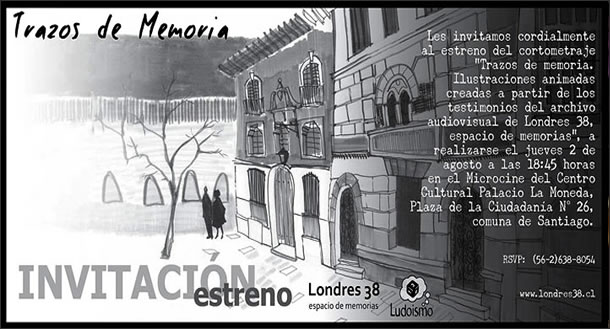
Trazos de Memoria

Trazos de Memoria
Illustraciones animadas creadas a partir de los testimonios del archivio audiovisual de Londres 38, espacio de memorias
Londres 38, 2012.


Trazos de Memoria seeks to re-enact the recent history of Chile's dictatorship and its widespread torture and macabre annihilation of opponents. A short, illustrated text with testimonies from torture survivors and relatives of detenidos desaparecidos, the book imparts a sliver of memory narrative in flashes of recollections.

The testimonies are taken from Londres 38's audiovisual archive. Guillermo Rodriguez Morales (former MIR militant), Miguel Angel Rebolledo (former MIR militant), Mario Irarrazabal (survivor of Londres 38), Erika Hennings (former MIR militant, survivor of Londres 38 and wife of detenido desaparecido Alfonso Chanfreau), Luz Encina Silva (human rights activist and mother of detenido desaparecido Mauricio Jorquera Encina, former MIR militant) and Gastón Muñoz Briones (former MIR militant and torture survivor) disclose their experience of dictatorship practices, notably the struggle of each individual against the uncertainty of their plight.

As this book shows, the struggle against oblivion was a collective commencing far before Pinochet's insistence to obliterate memory with regard to torture and disappearances. Resisting lies regarding detention, blindfolds and unknown destinations, detainees relied on memory and verbal communication to construct their narratives and identity within history, in order to ensure recognition of other torture victims whose disappearance remains shrouded in violence and oblivion. A very striking testimony by Erika Hennings describes the manner in which detainees would describe themselves to others incarcerated with them - one of the women participating in this exercise was Muriel Dockendorff Navarrete, a disappeared former MIR militant whose name appears in the List of the 119, or Operacion Colombo.

The book is free to download from Londres 38 espacio de memorias. An innovative manner of imparting memory, I highly recommend this book for anyone willing to join the fight against dictatorship oblivion; also for others whose journey through history and memory needs to be rekindled.

Neither forgiveness, nor oblivion. A steadfast struggle for justice within memory.

Friday, July 20, 2012

Betraying Memory in Chile: Documental Pinochet's Manipulation of History

This article was first published in Upside Down World here.

Impunity and split memory in Chile were highlighted on June 10, 2012 with the screening of Documental Pinochet at Teatro Caupolican. Describing the event as an aberration, human rights groups in Chile launched a campaign which culminated in protests outside Teatro Caupolican, emphasizing the contradiction of honoring the dictator responsible for the torture and murder of thousands of Chileans within the parameters of democracy.

Documental Pinochet gives a glorifying account of the military coup and the dictatorship years up to Augusto Pinochet’s funeral. Focusing on the Pinochet rather than the nation, the documentary manipulates history in a manner which all but obliterates Salvador Allende and Unidad Popular. Branding socialists and members of MIR (Movimiento Izquierda Revolucionario) as terrorists, the documentary embraces impunity from the beginning, imparting a distorted justification of the coup while deftly eliminating all historical footage of repression.

Agrupacion Familiares de Detenidos Desaparecidos (AFDD), together with relatives of people who were tortured, murdered or disappeared during the dictatorship, filed an appeal for suspension of the documentary, reiterating that such a tribute could cause psychological harm to relatives who, after decades of repression, are still struggling to discover the fate of their relatives. Lorena Pizarro, speaking on behalf of AFDD stated that such a tribute will demean any declaration of “never again” with regard to genocide, [1] however, the Court ruled against the appeal, also accusing AFDD of issuing threats. AFDD’s initiative also garnered support from human rights lawyer Hugo Gutierrez, who denounced the tribute as a means to undermine the rights of the victims of state terrorism in order to pay homage to a criminal. Deputy Enrique Accorsi from Partido por la Democracia (PPD) stated the tribute was a direct attack on democracy and announced that a draft agreement would be presented to avoid such events in the future.[2]

The homage to Pinochet delves deeper than differences of opinion. By allowing the event to take place, the right wing’s approach to Chilean history has been to seek a manner in which the dictatorship’s crimes of torture and murder are legitimized within a distorted historical context. Senator Carlos Kuschel from Renovacion Nacional voiced the opinion that “President Pinochet deserves more tributes than the majority of leaders.”[3]

Pinochet’s grandson, Augusto Pinochet Molina evoked democracy to justify the tribute, stating that “people shouldn’t be afraid to express themselves ...We live in a democratic society with the rule of law and everyone can raise their points of view and act as necessary within that framework.” [4]

Lieutenant Juan Gonzalez, a retired army officer leading the Pinochetista movement and also an organizer of the tribute declared the documentary to be the means of setting the record straight on Chile. During an interview on CNN, Gonzalez described the coup as the saving of Chile, denying the widespread torture, murders and disappearances. Gonzalez’s own sister, Francisca denied these statements the very next day during an interview with the same news channel, declaring she was imprisoned and tortured in Punta Arenas during the dictatorship. [5]

Social networking, in particular Facebook and Twitter, provided a strong means of dissemination of information. A petition hosted at El Quinto Poder entitled Impidamos esta aberración[6], was widely circulated on Twitter. While the petition failed to garner the desired number of signatures within five days, it provided a vital focal point for those opposing the tribute. A steady stream of tweets paid homage to various desaparecidos, the 119 victims of Operacion Colombo and other victims of the dictatorship. The first photos published on Facebook pertained to demonstrations held in France and Brussels against the tribute to Pinochet.

The area surrounding Teatro Caupolican was characterized by a significant police presence. Human rights groups who sought to break through the police barrier to get closer to Teatro Caupolican were forced back with water cannons and tear gas. Opposition to the tribute was particularly assertive – besides families of the desaparecidos wearing photos of their disappeared relatives around their necks and holding placards as protest against the tribute, a re-enactment of torture was exhibited in the streets, with people blindfolded and tied to a replica of the parilla – a common torture device during the dictatorship which administered electric shocks to detainees.

As in a December 2011 protest against Chilean intelligence officer Miguel Krassnoff Martchenko’s homage, protestors were targeted and subjected to police violence. AFDD stated it held Minister of Interior Rodrigo Hinzpinter responsible for the violence and the manner in which police provided protection for the Pinochetistas. Protestors have also alleged that police dressed in civilian clothes infiltrated the crowd and made arbitrary arrests. [7]

Whilst Sebastian Piñera’s government kept its distance from the tribute, statements from the government’s general secretary bordered on the contradictory, stating “The government respects the activity because it is organized within legal parameters, but we won’t be participating.”[8]

Historian Alberto Harambour makes an important observation regarding the contradictions of the Chilean state. He says the tribute is indecent in its glorification of torture and destruction of freedom.[9] The incoherence of applying dictatorship laws of impunity to defend a dictatorship and manipulate history bears a resemblance to the earlier controversy of eliminating any mention of the dictatorship in primary school textbooks. Showing leniency to torture and torturers allows a widespread indulgence of human rights violations.
While the documentary has been pronounced as the product of over twenty years of silence and a means to disseminate the truth about the military coup, its manipulative stance reinforces the split memory of Chilean society. The right wing in Chile adhered to Pinochet’s strategy beyond his death by reiterating that torture, disappearances and murders never happened. However, propagating such distorted views in a documentary exceeds any possible rational acceptance of various truths and memories.

Documental Pinochet further annihilates the memory of the dictatorship victims by refusing to even acknowledge the widespread horror inflicted upon left wing Chileans by DINA and CNI. The refusal to acknowledge Chile’s era of repression is a manifestation of impunity.
Adolfo Pérez, 1980 Nobel Peace Prize winner, criticized the tribute, calling it an aberration.[10] Citing a broader perspective than a manipulation of history, Pérez raises the significance and impact of the tribute upon Chile, which is still shackled by laws dating back to Pinochet’s era. The documentary glorifies interventionism in Latin America and upholds the enforcement of anti-terror laws upon the Mapuche population and social movements. In the end, Documental Pinochet has caused uproar within the Chilean left largely because it betrays the nation’s struggle for justice and its own collective memory.

Ramona Wadi is a freelance writer living in Malta. Visit her blog here.
Photo source: http://yfrog.com/6hgzj

Source:

[1] http://www.eldinamo.cl/2012/06/06/familiares-de-detenidos-desaparecidos-presentan-recurso-contra-homenaje-a-pinochet/
[2] http://www.biobiochile.cl/2012/06/03/familias-de-victimas-acuden-a-la-justicia-para-evitar-homenaje-a-pinochet.shtml
[3] http://www.biobiochile.cl/2012/06/06/senador-kuschel-el-presidente-pinochet-merece-mas-homenajes-que-la-mayoria-de-los-mandatarios.shtml
[4] http://www.biobiochile.cl/2012/06/10/nieto-de-pinochet-defiende-derecho-a-manifestarse-de-partidarios-al-regimen-militar.shtml
[5] http://www.diarioreddigital.cl/index.php?option=com_content&view=article&id=7786%3Ala-catadura-moral-de-los-organizadores-del-qhomenajeq-a-pinochet&catid=74%3Avideos-derechos-humanos&Itemid=92
[6] http://www.elquintopoder.cl/acciones/impidamos-esta-aberracion-noalhomenajeapinochet/
[7] http://radio.uchile.cl/noticias/156601/
Also see http://upsidedownworld.org/main/chile-archives-34/3356-dictatorship-relics-in-chile-paying-homage-to-miguel-krassnoff-martchenko
[8] http://radio.uchile.cl/noticias/155343/
[9] http://www.elquintopoder.cl/sociedad/para-la-libertad-homenaje-a-pinochet/
[10] http://www.lanacion.cl/adolfo-perez-esquivel-homenaje-a-pinochet-es-una-aberracion/noticias/2012-06-05/132002.html

Wednesday, May 9, 2012

The Right to Memory in Chile: An Interview with Erika Hennings, President of Londres 38

This article was first published in Upside Down World here 

Operacion Colombo, or the case of the 119[1] was an intelligence operation staged by DINA (Dirección de Inteligencia Nacional), which sought to exterminate political opponents of Pinochet’s dictatorship. Most of the victims were members of MIR. Having first been detained in Londres 38[2], most of the detained persons were ‘disappeared’[3] by DINA. In what amounted to a treacherous conspiracy, Pinochet’s dictatorship allied itself with other repressive governments in Latin America, seeking to influence public opinion about the fate of the desaparecidos by publishing articles about supposed political turbulence within the left which led MIR members to turn against each other.

In memory of the desaparecidos, as well as an assertion in favor of the right to memory, Londres 38: Espacio de Memorias inaugurated an exhibition detailing the origins and set up of Operacion Colombo. Erika Hennings, President of Londres 38, speaks about the right to memory – a contrast with state laws and dictatorship practices which act as censorship or criminalization of social mobilization in Chilean society.

Ramona Wadi: Explain the historical connection between Operacion Colombo and Londres 38.
Erika Hennings:
The victims of Operacion Colombo are all people arrested by DINA, whose systematic method of disappearance started in Londres 38. That location was a place of detention, torture and extermination of people, mostly leftist militants during that particular period of MIR. DINA devoted itself primarily to the extermination of MIR (Movimiento Izquierda Revolucionaria). Besides the missing victims there are innumerable persons who survived their detention in Londres 38, and were witnesses of the detention and missing of people who are in the 119 list, and therefore are also witnesses of the farce and set-up which was realized to conceal the facts.

RW: What was the dictatorship’s aim in orchestrating Operacion Colombo? How did other governments in Latin America collaborate with DINA’s manipulation of events?

EH: Operacion Colombo was staged by the repression of the dictatorship, together with its intelligence agency, DINA, to conceal their crimes, most of which still remain unpunished. Operacion Colombo was part of Operacion Condor, which coordinated the repressive apparatus of the Southern Cone together with the participation of agency officials such as embassies and news media. With the repressive Argentine intelligence and complicity of the Chilean press, such as El Mercurio, La Segunda and La Tercera, the dictatorship found a way to sway public opinion with regard to the desaparecidos, attributing their deaths to internal leftist political strife, especially with regard to MIR. In this context, the Chilean press reports reproduced information published in journals: Lea in Argentina and Novo O Díain Argentina and Brazil, which ‘clarified’ the whereabouts and circumstances of the 119 persons. The first of these publications reported about the fate of 60 desaparecidos, while the others reported about the remaining 59.

RW: Has any information resurfaced about the fate of the victims? Can you relate the stories of any of the desaparecidos?

EH: In the case of persons disappeared by DINA, the 119 and the other hundreds of desaparecidos, there has never been any confirmed information relating to their fate.

RW: What does the exhibition attempt to convey and how does it challenge current laws and impunity in Chile?

EH: The exhibition “Montajes Comunicacionales del pasado y el presente” arises out of a need to visualise the operations conducted by the dictatorship to hide their crimes, most of which still remain unpunished due to impunity.

The Courts of Justice are still investigating the case of Operacion Colombo; family members and human rights agencies hold a firm conviction that permanent struggle and determination can support the achievement of justice. Some condemnations have been achieved in a few cases of the desaparecidos, however sentences have not been harsh and many cases still fall under the impunity.

At the same time it is necessary not only to achieve permanent mobilization against cases in the recent past, but also towards present cases which are a continuity of practices from the dictatorship. State security law and the anti terrorist law are being used to criminalize all social mobilization.

RW:
How did the idea for the exhibition originate? Describe the exhibition and what it seeks to portray through the various mediums used.

EH: Londres 38, Espacio de Memorias, raises the significance of memory that links them to the present, in order to release knowledge that may lead to reflection and action on what is occurring today, which should generate a contribution to legal and social justice, as well as respect for human rights in its broadest perception.

This exhibition traces the origins of Operacion Colombo. Panels portray the origin of Operacion Colombo, its context and its relationship to other frame ups such as Operacion Salamandra, also known as El Caso Bombas. The exhibition also includes life size silhouettes of the missing 119 detainees, whose detention and attempted murder was denied by those orchestrating Operacion Colombo.

RW: What effect does this exhibition have on memory and citizenship and how does it establish a link between relatives of the desaparecidos and the public?

EH:
I can’t say what effect this exhibition had, but the wide participation of the citizens in this effort meets the goal of imparting knowledge about what happened and delivers elements which make it possible for people to reflect on how impunity allows the continuity and repetition of facts to silence all social and political mobilization. The relatives of the desaparecidos are part of the ‘public’, part of the citizens – they are informed and mobilized.

RW: Has the exhibition compelled people to come forward with any information relating to Operacion Colombo or other dictatorship related torture?

EH: The people approach, discuss, they comment with regard to the exhibition, they wonder and question. There is a perceived great interest to discover and link with other cases of frame ups which they have known or heard of.

RW: How does the exhibition challenge Chilean media and is there any repetitive pattern in media manipulation from the dictatorship era?

EH: A leading role was played by the press addicted to the dictatorship. Chile’s media and journalists from the media provided space in their pages to try to give credibility to the lie known as Operacion Colombo. More than 30 years later, media such as La Segunda, El Mercurio and La Tercera have never given an explanation about their lies and complicity with these crimes. They enjoy total impunity. It is this impunity that allows more than 30 years later, journalistic practices which are complicit in political, economic, religious, the police and any other kind of power. Empowered by the same impunity, the media which in the past participated in Operacion Colombo now echo, without ever questioning police versions, or else in collusion with government prosecutors, the cases which affect the Mapuche people or young anarchists.

The Patriot Act, the law of state security and the press have been used in these years of democracy as means to criminalize social movements and struggles. More recently, the prosecution was unable to sustain terrorism charges against young anarchists whilst the media had already condemned them.

RW: How much would you say the right to memory is respected in Chile, and can you speak about any contrasts between Chilean civilians opposing the dictatorship and the government, with respect to the right to memory?

EH: The exhibition “Montajes comunicacionales del pasado y el presente” was scheduled to be launched in January this year at the Library of Santiago, but the entity attempted to modify the contents of the exhibition – an act of censorship that was rejected by Londres 38, Espacio de Memorias.

For Londres 38, Espacio de Memorias, modifying the contents of the exhibition by a public body not only violated editorial principles but also, the attempt at censorship contradicted the principles of the International Federation of Library Associations and Institutions (IFLA) and specifically, those posed by its Committee of freedom of expression and access to information, which states that libraries contribute to the development and maintenance of intellectual freedom and help safeguard basic democratic values and universal civil rights. Furthermore, it states that libraries should acquire, organize and disseminate information freely and oppose any form of censorship. Also libraries should preserve and make available the widest variety of materials reflecting the plurality and diversity of society, providing users with the ability to communicate and express themselves; which should not be censored or restricted by policy approaches.

In this sense, Londres 38, Espacio de Memorias, defends its right to maintain and preserve its editorial policy, where the contents of memory retrieval are a necessity related to the present. Similarly, Londres 38 states that the state has the obligation to guarantee the right to memory; it should ensure the plural use of public spaces for citizens’ organizations. After a meeting with the Director of the Dibam (Dirección de Bibliotecas, Archivos y Museos), on whom the library of Santiago depends, it was decided that the exhibition would be displayed on the site as originally designed by Londres 38, Espacio de Memorias.

For now the show will remain in Londres 38 until April 25. Immediately after that date, the exhibition will be visiting various facilities of the Universities of Chile and Catholic Universities – organized by their respective student federations - municipalities such as La Granja, San Miguel and San Joaquin, as well as library spaces of independent publishers such as GAM and Museo de la Memoria.


Ramona Wadi is a freelance writer living in Malta. Visit her blog here.

Notes:

Sunday, January 22, 2012

A Temporary Suspension of Exile: Interview with Former MIR Militant Hugo Marchant

This interview was first published in Upside Down World here.
Photo courtesy of Luis Fernando Arellano, FlickrChile’s supreme court of appeals has temporarily suspended the exile sentence imposed upon an ex-militant of the Movimiento de Izquierda Revolucionaria (MIR). Hugo Marchant was detained in 1973 for distributing leaflets containing anti-Pinochet propaganda and later became a member of the (MIR) while in exile. Marchant entered Chile clandestinely in 1980 as part of a guerilla group opposing Pinochet’s dictatorship.

Accused of involvement in the killing of Santiago General Carol Urzúa Ibáñez, Marchant and his family were arrested and tortured by Centro Nacional de Intelligencia (CNI) agents. Following nine years of imprisonment, Marchant’s sentence was commuted to exile during Patricio Aylwin’s presidency. Founded in 1965 by left-wing students, MIR quickly established support in Santiago, especially from working class neighborhoods. MIR supported Salvador Allende; however the group expected more radical social reforms. Nevertheless, prior to the military coup, MIR began contacting junior officers within the army, urging them to support the civilian elected government. With Allende overthrown by Pinochet’s military dictatorship in 1973, MIR were targeted and thousands of members, including the leaders, were arrested and killed, with those surviving the clampdown fleeing from Chile.

Marchant's previous attempts to enter Chile were quickly repudiated by the Chilean authorities. Now nearing the end of his first exile sentence, Marchant’s renewed attempt to enter Chile brought about a legal triumph. Upon presenting his passport, Marchant found himself detained by the police and subsequently deported to Buenos Aires, where he awaited the final decision of Chile’s supreme court of appeals. Echoing Marchant’s adamant opinion that legalities were in his favour, the judiciary declared the temporary lifting of the exile, granting Marchant fifteen days, starting on December 29, 2011 at 9:30am, to visit Chile and be reunited with his family.
The appeal has garnered a lot of media attention as well as support from human rights and activists groups. It is estimated that between 1500 – 2000 MIR militants have been killed, exiled or disappeared by the Pinochet dictatorship. A few ex-militants remain exiled; their sentences will be nearing completion between 2012 and 2014.

The supreme court declared that Chile had transgressed the 1993-1994 American Convention of Human Rights (Article 22:5) and the Pact of Civil and Political Rights (Article 12:4) which specifically states that no one can be banished from national territory and no one can arbitrarily prevent anyone from re entering one’s own country.

Ramona Wadi: How did you become involved in MIR?
Hugo Marchant: I was a member of Frente de Estudiantes Revolucionarions (FER) during my years as a student at the military high school. FER was the students’ social front of (MIR). In 1977 I entered the party while in exile.

RW: What was your role within the movement?

HM: I was to enter Chile clandestinely in November 1980, as part of the Central Force in the area of logistics.

RW: At what point during Pinochet's dictatorship were you and your family arrested?
HM: On Tuesday September 7, 1980 at 13:45pm I was stopped by a score of Central Nacional de Inteligencia (CNI) agents in the San Pablo con Bandera province. My family was arrested by the same intelligence body in Serrano. The agents arrested my wife, Silvia Sepulveda Aedo, my daughter Javiera who was eight months old, and my son Pablo, aged 4. My son, Simon, was hidden by neighbors for three days in the attic of a neighbouring house. My wife held Javiera in her arms while Pablo played with a little car in a cell at the CNI headquarters. The memory of these moments – the interrogation and torture, is so horrendous I cannot bear to talk about it.

RW: How did your memory of Chile alter during the nine years in prison and the subsequent nineteen years exiled in Finland?

HM: The nine years of imprisonment and nineteen years of banishment, exile, have not alienated me from my country or the struggle for Chile. Through the press, the reading of several testimonies has allowed me to retain the reality. The cruelty of this enforced exile is the emotional upheaval. I cannot walk with my kids and my wife through the streets which witnessed our struggles. I have been unable to mourn at the graves of my fallen comrades in battle. I failed to attend my mother’s funeral. Exile has prevented me from standing with the Mapuche people who are under military occupation of their land by the government in power. I have also been unable to accompany the students in their struggles. And during each day which passes in exile, I know I am suffering a wrongful conviction since fighting injustice and oppression is a legitimate cause.

RW: Did the Valech Commission* report have any effect on your case?

HM: The Valech report notes the violation of human rights committed in Chile and supports our defense. However, a new trial never materialized for me.

RW: What was the response from the government with regard to your case?

HM: The government’s response was a resounding 'NO'. Not even the unanimous decision from the Commission of Human Rights in parliament, neither the authorisation allowing us time to file an appeal at the Appeals Court, were an impediment for the government to express its hatred for our history.

RW: Has your case created more awareness about the plight of exiled political prisoners in Chile?

HM: The strategy of attempting direct entry into Chile through the airport has been effective in demonstrating the injustice of exile. The laws of the state are in our favor, however the government reacted violently and expelled us. The publicity generated by the media garnered the attention of various social and political groups both nationally and internationally, effectively extending our campaign to terminate this exile. Social movements in Chile have expressed support in a concrete way for our cause. On an international level, a complaint is being filed with the Inter American Court of Human Rights since the state of Chile is violating international treaties to which it is supposed to adhere to.

RW: What do you think will influence the final decision of the appeal? The government or the judiciary?

HM: This is clear – a look at the history of political prisoners and judicial proceedings will show that the judiciary is the only way through which the political confrontation between the popular sectors in struggle and the state of domination or governance can be expressed. With our campaign, political facts have been installed in the political scene. Therefore if we continue accumulating the social and political support with our campaign, we will achieve a force that allows us to realize major actions. Meanwhile our people’s advances in pursuing the fight for human rights will change the legal results. At the international level it is important to perform specific tasks to raise awareness and opposition, such as sending letters to the Judiciary, the Ministry of Interior, The President of the Republic and repudiating manifest injustices such as banishment, exile and forced exile. Collection of signatures should be sent to Comite Fin Al Destierro Ahora – our committee which campaigns to end exile. Every initiative in favor of human rights, every stand against banishment, is a necessary initiative.

*The Valech Commission report is a record of abuses committed in Chile between 1973 - 1990, documenting over 38,000political prisoners - most of them tortured.