Showing posts with label Londres 38. Show all posts

Friday, May 3, 2013

Four DINA agents sentenced for the disappearance of María Cecilia Labrín Saso

On April 30, 2013 Judge Leopoldo Lanos sentenced former DINA agents Manuel Contreras Sepulveda, Miguel Krassnoff Martchenko, Marcelo Moren Brito and Basclay Zapata Reyes to ten years imprisonment for the detention and disappearace of MIR militant María Cecilia Labrín Saso.

Labrín, aged 25, was detained on August 12, 1974 in the presence of her family by DINA agents, while resting due to a difficult pregnancy. The supposedly brief interrogation evolved into disappearance as the family sought information about Labrin's whereabouts in vain. Testimony by former MIR militant and torture survivor Erika Hennings place Labrin at Londres 38 and tortured by Contreras, Krassnoff, Brito and Reyes. Other detainees, such as Oscar Armando Alfaro Cordova (detained in July 1974) and Raul Alberto Iturra Munoz (detained in January1974) testify to her presence in Londres 38 and Cuatro Alamos respectively. According to evidence provided in court, it is documented that Labrin was transferred and held in Cuatro Alamos on August 17, 1974, accused of participation in MIR related activities.

Labrin's presence at Londres 38 was also witnessed by former MIR militant turned DINA collaborator Luz Arce Sandoval. Arce's testimony before the Rettig Commission provided a wealth of information about the intricacies of DINA and 'justification' for the betrayal of MIR militants and comrades, which she insists only damaged the 'peripheral' structure of the leftist organisation(Lazzara, 2011).

Questioned about DINA's operations in Londres 38, Contreras stated that he 'knew of its existence' but was not knowledgeable about the objectives. despite the lack of collaboration in behalf of Contreras, the court was able to provide evidence of collaboration in the detention, torture and disappearance of Labrin through testimony by other DINA agents including co-accused Reyes, as well as information and evidence garnered from the Truth and Reconciliation Report, which identified Contreras as in command of all operations pertaining to structure, organisation and detention centres.

Krassnoff sought to reinvent his role as torturer into that of an analyst undertaking intelligence studies with regard to 'terrorist groups like MIR' - a statement contradicted by numerous witnesses, including Erika Hennings as well as co-accused Reyes who gave evidence about the structure of Brigada Halcon and Krassnoff's role in persecuting MIR militants.

Denials by the accused reeked of the impunity and secrecy which DINA availed itself of. To this day, there is no information as to how the disappearance of Labrin was carried out.
 

Tuesday, April 2, 2013

Former DINA agent Cristian Labbe appointed lecturer of political thought


FotoInstead of facing justice for the atrocities committed during Pinochet's dictatorship, former DINA agent, torture instructor and ex-mayor of Providencia Cristian Labbe has been appointed lecturer of 'Evolution in Political Thought in Chile' at the Santiago Unviersity of Finis Terrae. The university's student federation claimed it was not alerted to Labbe's appointment.

Spontaneous protests eurpted on campus on Labbe's first day at university, with indignation spreading on social media. Tweets exhibiting the hashtag  #EnLasClasesDeLabbé created a parody out of the situation, refusing to wallow in oblivion and constructing a parallel to the colonel's stint in DINA. "Those who copy will be detained for three days." "Physical activity will be conducted in the Estadio Nacional." References to torture, including the parilla, and the omnipresence of DINA were not omitted from tweets. In an interview, Labbe's son declared "It has not been easy for my father to reinvent himself."

Labbe's stint in DINA is highlighted by the following.

Apart from his role in Tejas Verdes, Labbe was also instrumental in instructing and administering torture at Rocas de Santo Domingo, Venda Sexy, Villa Grimaldi and Londres 38. Testimony from torture survivors recall Labbe in his role as torturer, applying electric shocks to detainees.

Labbe was also involved in the repression and murder of fifteen peasants in Valdivia, who are listed as desaparecidos.

Collaborated  with his close friend Miguel Krassnoff  Martchenko and Ingrid Olderock.

Involved in Operacion Colombo, which targeted and annihilated MIR and Communist Party militants. The intention of the dictatorship was to deny these disappearances and attribute their deaths to a fabricated political strife between the socialist factions.

Following the Chilean transition to 'democracy', Labbe held influential positions and benefited from impunity, despite evidence linking him to atrocities committed during Pinochet's reign. As mayor of Providencia, Labbe employed Erasmo Sandoval Arancibia; also known as Pete el Negro, condemned in 2007 of murdering the youngest victim of the dictatorship - a fourteen year old boy who was shot four times and doused with gasoline. Arancibia also formed part of the DINA operation known as Operacion Retiro de Televisores, an encrypted message instructing agents to move the remains of desaparecidos from Cuesta Barriga and dispose of them permanently by incineration or deposed into the sea from helicopters to ensure dispersion.

Reinventing one's self from torture instructor to a 'professor' of political thought is a mere superficial process. If Labbe has encountered any difficulty in his 'reinvention', it would be the futility of reinventing Chilean individual and collective memory which has proved resilient against Pinochet's enforced culture of oblivion.


Sunday, August 12, 2012

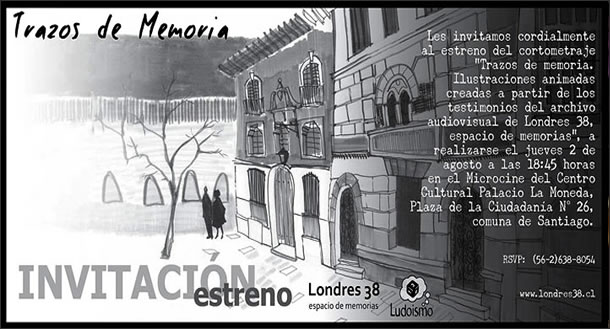
Trazos de Memoria

Trazos de Memoria
Illustraciones animadas creadas a partir de los testimonios del archivio audiovisual de Londres 38, espacio de memorias
Londres 38, 2012.


Trazos de Memoria seeks to re-enact the recent history of Chile's dictatorship and its widespread torture and macabre annihilation of opponents. A short, illustrated text with testimonies from torture survivors and relatives of detenidos desaparecidos, the book imparts a sliver of memory narrative in flashes of recollections.

The testimonies are taken from Londres 38's audiovisual archive. Guillermo Rodriguez Morales (former MIR militant), Miguel Angel Rebolledo (former MIR militant), Mario Irarrazabal (survivor of Londres 38), Erika Hennings (former MIR militant, survivor of Londres 38 and wife of detenido desaparecido Alfonso Chanfreau), Luz Encina Silva (human rights activist and mother of detenido desaparecido Mauricio Jorquera Encina, former MIR militant) and Gastón Muñoz Briones (former MIR militant and torture survivor) disclose their experience of dictatorship practices, notably the struggle of each individual against the uncertainty of their plight.

As this book shows, the struggle against oblivion was a collective commencing far before Pinochet's insistence to obliterate memory with regard to torture and disappearances. Resisting lies regarding detention, blindfolds and unknown destinations, detainees relied on memory and verbal communication to construct their narratives and identity within history, in order to ensure recognition of other torture victims whose disappearance remains shrouded in violence and oblivion. A very striking testimony by Erika Hennings describes the manner in which detainees would describe themselves to others incarcerated with them - one of the women participating in this exercise was Muriel Dockendorff Navarrete, a disappeared former MIR militant whose name appears in the List of the 119, or Operacion Colombo.

The book is free to download from Londres 38 espacio de memorias. An innovative manner of imparting memory, I highly recommend this book for anyone willing to join the fight against dictatorship oblivion; also for others whose journey through history and memory needs to be rekindled.

Neither forgiveness, nor oblivion. A steadfast struggle for justice within memory.

Wednesday, May 9, 2012

The Right to Memory in Chile: An Interview with Erika Hennings, President of Londres 38

This article was first published in Upside Down World here 

Operacion Colombo, or the case of the 119[1] was an intelligence operation staged by DINA (Dirección de Inteligencia Nacional), which sought to exterminate political opponents of Pinochet’s dictatorship. Most of the victims were members of MIR. Having first been detained in Londres 38[2], most of the detained persons were ‘disappeared’[3] by DINA. In what amounted to a treacherous conspiracy, Pinochet’s dictatorship allied itself with other repressive governments in Latin America, seeking to influence public opinion about the fate of the desaparecidos by publishing articles about supposed political turbulence within the left which led MIR members to turn against each other.

In memory of the desaparecidos, as well as an assertion in favor of the right to memory, Londres 38: Espacio de Memorias inaugurated an exhibition detailing the origins and set up of Operacion Colombo. Erika Hennings, President of Londres 38, speaks about the right to memory – a contrast with state laws and dictatorship practices which act as censorship or criminalization of social mobilization in Chilean society.

Ramona Wadi: Explain the historical connection between Operacion Colombo and Londres 38.
Erika Hennings:
The victims of Operacion Colombo are all people arrested by DINA, whose systematic method of disappearance started in Londres 38. That location was a place of detention, torture and extermination of people, mostly leftist militants during that particular period of MIR. DINA devoted itself primarily to the extermination of MIR (Movimiento Izquierda Revolucionaria). Besides the missing victims there are innumerable persons who survived their detention in Londres 38, and were witnesses of the detention and missing of people who are in the 119 list, and therefore are also witnesses of the farce and set-up which was realized to conceal the facts.

RW: What was the dictatorship’s aim in orchestrating Operacion Colombo? How did other governments in Latin America collaborate with DINA’s manipulation of events?

EH: Operacion Colombo was staged by the repression of the dictatorship, together with its intelligence agency, DINA, to conceal their crimes, most of which still remain unpunished. Operacion Colombo was part of Operacion Condor, which coordinated the repressive apparatus of the Southern Cone together with the participation of agency officials such as embassies and news media. With the repressive Argentine intelligence and complicity of the Chilean press, such as El Mercurio, La Segunda and La Tercera, the dictatorship found a way to sway public opinion with regard to the desaparecidos, attributing their deaths to internal leftist political strife, especially with regard to MIR. In this context, the Chilean press reports reproduced information published in journals: Lea in Argentina and Novo O Díain Argentina and Brazil, which ‘clarified’ the whereabouts and circumstances of the 119 persons. The first of these publications reported about the fate of 60 desaparecidos, while the others reported about the remaining 59.

RW: Has any information resurfaced about the fate of the victims? Can you relate the stories of any of the desaparecidos?

EH: In the case of persons disappeared by DINA, the 119 and the other hundreds of desaparecidos, there has never been any confirmed information relating to their fate.

RW: What does the exhibition attempt to convey and how does it challenge current laws and impunity in Chile?

EH: The exhibition “Montajes Comunicacionales del pasado y el presente” arises out of a need to visualise the operations conducted by the dictatorship to hide their crimes, most of which still remain unpunished due to impunity.

The Courts of Justice are still investigating the case of Operacion Colombo; family members and human rights agencies hold a firm conviction that permanent struggle and determination can support the achievement of justice. Some condemnations have been achieved in a few cases of the desaparecidos, however sentences have not been harsh and many cases still fall under the impunity.

At the same time it is necessary not only to achieve permanent mobilization against cases in the recent past, but also towards present cases which are a continuity of practices from the dictatorship. State security law and the anti terrorist law are being used to criminalize all social mobilization.

RW:
How did the idea for the exhibition originate? Describe the exhibition and what it seeks to portray through the various mediums used.

EH: Londres 38, Espacio de Memorias, raises the significance of memory that links them to the present, in order to release knowledge that may lead to reflection and action on what is occurring today, which should generate a contribution to legal and social justice, as well as respect for human rights in its broadest perception.

This exhibition traces the origins of Operacion Colombo. Panels portray the origin of Operacion Colombo, its context and its relationship to other frame ups such as Operacion Salamandra, also known as El Caso Bombas. The exhibition also includes life size silhouettes of the missing 119 detainees, whose detention and attempted murder was denied by those orchestrating Operacion Colombo.

RW: What effect does this exhibition have on memory and citizenship and how does it establish a link between relatives of the desaparecidos and the public?

EH:
I can’t say what effect this exhibition had, but the wide participation of the citizens in this effort meets the goal of imparting knowledge about what happened and delivers elements which make it possible for people to reflect on how impunity allows the continuity and repetition of facts to silence all social and political mobilization. The relatives of the desaparecidos are part of the ‘public’, part of the citizens – they are informed and mobilized.

RW: Has the exhibition compelled people to come forward with any information relating to Operacion Colombo or other dictatorship related torture?

EH: The people approach, discuss, they comment with regard to the exhibition, they wonder and question. There is a perceived great interest to discover and link with other cases of frame ups which they have known or heard of.

RW: How does the exhibition challenge Chilean media and is there any repetitive pattern in media manipulation from the dictatorship era?

EH: A leading role was played by the press addicted to the dictatorship. Chile’s media and journalists from the media provided space in their pages to try to give credibility to the lie known as Operacion Colombo. More than 30 years later, media such as La Segunda, El Mercurio and La Tercera have never given an explanation about their lies and complicity with these crimes. They enjoy total impunity. It is this impunity that allows more than 30 years later, journalistic practices which are complicit in political, economic, religious, the police and any other kind of power. Empowered by the same impunity, the media which in the past participated in Operacion Colombo now echo, without ever questioning police versions, or else in collusion with government prosecutors, the cases which affect the Mapuche people or young anarchists.

The Patriot Act, the law of state security and the press have been used in these years of democracy as means to criminalize social movements and struggles. More recently, the prosecution was unable to sustain terrorism charges against young anarchists whilst the media had already condemned them.

RW: How much would you say the right to memory is respected in Chile, and can you speak about any contrasts between Chilean civilians opposing the dictatorship and the government, with respect to the right to memory?

EH: The exhibition “Montajes comunicacionales del pasado y el presente” was scheduled to be launched in January this year at the Library of Santiago, but the entity attempted to modify the contents of the exhibition – an act of censorship that was rejected by Londres 38, Espacio de Memorias.

For Londres 38, Espacio de Memorias, modifying the contents of the exhibition by a public body not only violated editorial principles but also, the attempt at censorship contradicted the principles of the International Federation of Library Associations and Institutions (IFLA) and specifically, those posed by its Committee of freedom of expression and access to information, which states that libraries contribute to the development and maintenance of intellectual freedom and help safeguard basic democratic values and universal civil rights. Furthermore, it states that libraries should acquire, organize and disseminate information freely and oppose any form of censorship. Also libraries should preserve and make available the widest variety of materials reflecting the plurality and diversity of society, providing users with the ability to communicate and express themselves; which should not be censored or restricted by policy approaches.

In this sense, Londres 38, Espacio de Memorias, defends its right to maintain and preserve its editorial policy, where the contents of memory retrieval are a necessity related to the present. Similarly, Londres 38 states that the state has the obligation to guarantee the right to memory; it should ensure the plural use of public spaces for citizens’ organizations. After a meeting with the Director of the Dibam (Dirección de Bibliotecas, Archivos y Museos), on whom the library of Santiago depends, it was decided that the exhibition would be displayed on the site as originally designed by Londres 38, Espacio de Memorias.

For now the show will remain in Londres 38 until April 25. Immediately after that date, the exhibition will be visiting various facilities of the Universities of Chile and Catholic Universities – organized by their respective student federations - municipalities such as La Granja, San Miguel and San Joaquin, as well as library spaces of independent publishers such as GAM and Museo de la Memoria.


Ramona Wadi is a freelance writer living in Malta. Visit her blog here.

Notes:

Sunday, January 22, 2012

Dictatorship Relics in Chile: Paying homage to Miguel Krassnoff Martchenko

This article was first published in Upside Down World here.
Photo by Luis Fernando Arellano, http://www.flickr.com/photos/reporteos/In another event which exposes the reality of Chilean society’s split memory, an homage to former Dirección de Inteligencia Nacional (DINA) officer Miguel Krassnoff Martchenko was described as an exercise in freedom of expression by mayor  of Providencia Christian Labbé, in turn prompting outrage and protests from human rights and activist groups in Chile since its announcement.

On November 21, Labbé organised a book launch for the 4th edition of right wing historian Gisela Silva Encina’s Miguel Krassnoff: Prisoniero Por Servir a Chile (Miguel Krassnoff: A Prisoner for Serving Chile). A letter from Krassnoff[1] was read during the event, in which he described his incarceration as ‘illegal, illegitimate and unconstitutional’. Hundreds of activists and relatives of tortured victims gathered to protest the event, some holding placards stating “I don’t forget, nor forgive”. Others turned up with photographs of tortured, assassinated or missing relatives. Protestors hurled eggs and stones in the direction of Club Providencia, resulting in clashes between opposing groups and the use of force and tear gas against protestors by the Chilean police. Earlier that day another indictment was issued against Krassnoff, charging him and three other DINA officers with the kidnapping of Newton Morales Saavedra in 1974.[2]

A message relayed by one of President Sebastian Piñera’s assistants stated that while the President was unable to attend, he wished the event success, bearing in mind that “Krassnoff is a representative symbol of the 1973 – 1978 era.”[3] Following the protests, Piñera issued a retraction, saying the initial message was not his and there was no way his government would have participated in such an event.

Krassnoff was sentenced to 144 years in prison in 2006 for over 20 counts of crimes against humanity. A graduate of the School of the Americas (SOA) and renowned for anti-Marxist sentiment, Krassnoff took part in the September 11, 1973 military coup d’état which ousted President Salvador Allende. Having been in charge of DINA’s Brigada Halcon, Krassnoff was at the helm of Pinochet’s secret service which kidnapped, tortured and assassinated members of Movimiento de Izquierda Revolucionaria de Chile (MIR) – who had formed a paramilitary resistance against Pinochet’s dictatorship. Those arrested were taken to Villa Grimaldi and Londres 38, torture complexes which operated from 1974 to 1978.

According to Stern (Reckoning with Pinochet: The Memory Question in Democratic Chile 1989 – 2006) 4,500 prisoners were tortured from 1974 – 1976; including 205 disappearances. Survivors of torture recount extreme atrocities committed against prisoners. Sheila Cassidy, a British doctor living in Chile at the time of the coup, was arrested and tortured with electric shocks on the accusation of medically treating a Pinochet opponent. Paul Hammer[4], a law student arrested on suspicion of membership in a left-wing paramilitary group states he was beaten, shocked and brought to the verge of suffocation. Another torture survivor of Villa Grimaldi, Pedro Matta[5] was arrested in 1975 and taken to Villa Grimaldi. His extensive research sheds light on the methods and manner of torture.

Prisoners who refused to become collaborators for DINA were kept standing for long hours in tiny cells, torturers submerged the prisoners’ heads in putrid water, others were subjected to the shattering of limbs, performed by a guard who would drive a vehicle over the victim’s legs. Sexual abuse and torture against women was particularly sadistic, which included rape, using animals to sexually abuse women and the burning of genitals. Influential prisoners who refused to succumb to the interrogator’s demands were usually anesthetised, taken on board a helicopter and thrown into the ocean. This elimination of opponents was also affirmed by Cassidy.
Labbé, a personal friend of Krassnoff since their time at the (SOA)[6], so far remains unscathed by the law. A former body guard of Krassnoff, he later formed part of Brigada Halcon, given the duty of instructing guards in torture methods. Reiterating that he allowed the use of Club Providencia each time there was a commemoration pertaining to the Pinochet era, Labbé considers the event as honouring part of Chile’s history. Notwithstanding his role in Villa Grimaldi, Labbé continues to enjoy the authorities’ support and has contested council elections, retaining his place as Mayor since his first campaign.

Despite the testimonies from survivors and reports drawn up by the Valech and Rettig commissions; Chilean society remains split over the dictatorship era. According to Krassnoff’s declaration in the letter read during the book launch, “the military coup didn’t happen. It was a legitimate military intervention.” Once again, memory and blame are displaced. Pinochet’s initial declaration to allegations of human rights abuses, “Sometimes democracy must be bathed in blood” was mellowed through the years into a mission of refuting evidence of torture and murder through the discrepancy oblivion, as he stated in 1995, “The only solution to the issue of human rights is oblivion.”

As evidenced from Gisela Silva Encina’s blog[7] about Krassnoff, Pinochet supporters are in denial of the history of human rights abuses, assassinations and disappearances. Echoing a quote from Krassnoff, “I am a soldier who has been transformed into a persecuted politician.” Encina states that Krassnoff was the victim of lies and that no evidence incriminating Krassnoff was brought forward. Indeed, Dr Patricio Bustos, Head of Servicio Medico Legal, testified that he was tortured by Miguel Krassnoff[8], and that Krassnoff never used a pseudonym to conceal his identity[9]. The testimonies of victims were dismissed as memory manipulation. Encina’s blog also portrays the protestors as criminals attacking Pinochet supporters, thus necessitating the use of force on behalf of the police. Chile’s laws do not deem the celebration of genocide as a crime; therefore once again, victims and their relatives have been subjected to a travesty of justice.

However, the memory of the oppressed refuses to relinquish its stand. Lorena Pizarro, president of Agrupacion de Familiares de Detenidos Desparecidos (AFDD), condemned the homage[10], stating it portrayed Chile as a state which sanctions terrorism, as well as opening an avenue for a repetition of state terror. Alicia Lira, president of the Agrupacion de Familiares de Ejecution Politicos (AFEP) denounced the homage as an affront to memory and an example of the impunity which Piñera’s government is unwilling to counter, since many officers from the Pinochet era remain in authoritative positions.[11] On behalf of the AFDD, Pizarro is suing Labbé[12], demanding to know whether public funds were used to finance the event.


At a time when Chile is experiencing a surge in protests, notably the students’ protests demanding quality and free education, the event elicited responses from political figures. Head of Senate Guido Girardi denounced the homage[13], calling it “a tribute to torture, assassination and rape” and challenged Piñera to take measures against allowing Labbé to run for council elections in 2012. [14] “It is not possible that public authorities honor torturers and murderers … It is not democratic that your party supports a militant who has incurred faults that go against the constitution and the law … Labbé should be prevented from reapplying for office as he clearly has not responded as democracy demands.”

Notes: