Sunday, August 12, 2012

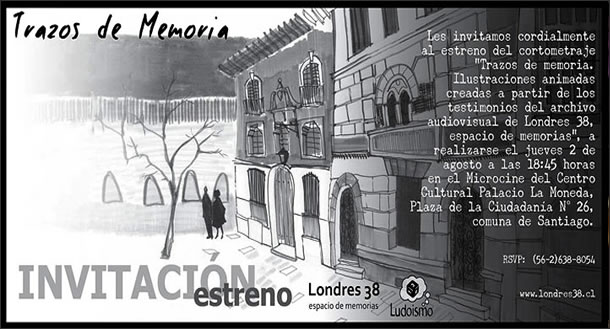
Trazos de Memoria

Trazos de Memoria
Illustraciones animadas creadas a partir de los testimonios del archivio audiovisual de Londres 38, espacio de memorias
Londres 38, 2012.


Trazos de Memoria seeks to re-enact the recent history of Chile's dictatorship and its widespread torture and macabre annihilation of opponents. A short, illustrated text with testimonies from torture survivors and relatives of detenidos desaparecidos, the book imparts a sliver of memory narrative in flashes of recollections.

The testimonies are taken from Londres 38's audiovisual archive. Guillermo Rodriguez Morales (former MIR militant), Miguel Angel Rebolledo (former MIR militant), Mario Irarrazabal (survivor of Londres 38), Erika Hennings (former MIR militant, survivor of Londres 38 and wife of detenido desaparecido Alfonso Chanfreau), Luz Encina Silva (human rights activist and mother of detenido desaparecido Mauricio Jorquera Encina, former MIR militant) and Gastón Muñoz Briones (former MIR militant and torture survivor) disclose their experience of dictatorship practices, notably the struggle of each individual against the uncertainty of their plight.

As this book shows, the struggle against oblivion was a collective commencing far before Pinochet's insistence to obliterate memory with regard to torture and disappearances. Resisting lies regarding detention, blindfolds and unknown destinations, detainees relied on memory and verbal communication to construct their narratives and identity within history, in order to ensure recognition of other torture victims whose disappearance remains shrouded in violence and oblivion. A very striking testimony by Erika Hennings describes the manner in which detainees would describe themselves to others incarcerated with them - one of the women participating in this exercise was Muriel Dockendorff Navarrete, a disappeared former MIR militant whose name appears in the List of the 119, or Operacion Colombo.

The book is free to download from Londres 38 espacio de memorias. An innovative manner of imparting memory, I highly recommend this book for anyone willing to join the fight against dictatorship oblivion; also for others whose journey through history and memory needs to be rekindled.

Neither forgiveness, nor oblivion. A steadfast struggle for justice within memory.

Thursday, August 2, 2012

La Cultura Rechaza Violencia Contra Pueblo Mapuche

A worldwide initiative by artists and intellectuals to publicly condemn state violence directed against the Mapuche people of Chile. Sign and share the petition to garner widespread support. http://www.g80.cl/noticias/noticiacompleta.php?varbajada=15824

Friday, July 20, 2012

Betraying Memory in Chile: Documental Pinochet's Manipulation of History

This article was first published in Upside Down World here.

Impunity and split memory in Chile were highlighted on June 10, 2012 with the screening of Documental Pinochet at Teatro Caupolican. Describing the event as an aberration, human rights groups in Chile launched a campaign which culminated in protests outside Teatro Caupolican, emphasizing the contradiction of honoring the dictator responsible for the torture and murder of thousands of Chileans within the parameters of democracy.

Documental Pinochet gives a glorifying account of the military coup and the dictatorship years up to Augusto Pinochet’s funeral. Focusing on the Pinochet rather than the nation, the documentary manipulates history in a manner which all but obliterates Salvador Allende and Unidad Popular. Branding socialists and members of MIR (Movimiento Izquierda Revolucionario) as terrorists, the documentary embraces impunity from the beginning, imparting a distorted justification of the coup while deftly eliminating all historical footage of repression.

Agrupacion Familiares de Detenidos Desaparecidos (AFDD), together with relatives of people who were tortured, murdered or disappeared during the dictatorship, filed an appeal for suspension of the documentary, reiterating that such a tribute could cause psychological harm to relatives who, after decades of repression, are still struggling to discover the fate of their relatives. Lorena Pizarro, speaking on behalf of AFDD stated that such a tribute will demean any declaration of “never again” with regard to genocide, [1] however, the Court ruled against the appeal, also accusing AFDD of issuing threats. AFDD’s initiative also garnered support from human rights lawyer Hugo Gutierrez, who denounced the tribute as a means to undermine the rights of the victims of state terrorism in order to pay homage to a criminal. Deputy Enrique Accorsi from Partido por la Democracia (PPD) stated the tribute was a direct attack on democracy and announced that a draft agreement would be presented to avoid such events in the future.[2]

The homage to Pinochet delves deeper than differences of opinion. By allowing the event to take place, the right wing’s approach to Chilean history has been to seek a manner in which the dictatorship’s crimes of torture and murder are legitimized within a distorted historical context. Senator Carlos Kuschel from Renovacion Nacional voiced the opinion that “President Pinochet deserves more tributes than the majority of leaders.”[3]

Pinochet’s grandson, Augusto Pinochet Molina evoked democracy to justify the tribute, stating that “people shouldn’t be afraid to express themselves ...We live in a democratic society with the rule of law and everyone can raise their points of view and act as necessary within that framework.” [4]

Lieutenant Juan Gonzalez, a retired army officer leading the Pinochetista movement and also an organizer of the tribute declared the documentary to be the means of setting the record straight on Chile. During an interview on CNN, Gonzalez described the coup as the saving of Chile, denying the widespread torture, murders and disappearances. Gonzalez’s own sister, Francisca denied these statements the very next day during an interview with the same news channel, declaring she was imprisoned and tortured in Punta Arenas during the dictatorship. [5]

Social networking, in particular Facebook and Twitter, provided a strong means of dissemination of information. A petition hosted at El Quinto Poder entitled Impidamos esta aberración[6], was widely circulated on Twitter. While the petition failed to garner the desired number of signatures within five days, it provided a vital focal point for those opposing the tribute. A steady stream of tweets paid homage to various desaparecidos, the 119 victims of Operacion Colombo and other victims of the dictatorship. The first photos published on Facebook pertained to demonstrations held in France and Brussels against the tribute to Pinochet.

The area surrounding Teatro Caupolican was characterized by a significant police presence. Human rights groups who sought to break through the police barrier to get closer to Teatro Caupolican were forced back with water cannons and tear gas. Opposition to the tribute was particularly assertive – besides families of the desaparecidos wearing photos of their disappeared relatives around their necks and holding placards as protest against the tribute, a re-enactment of torture was exhibited in the streets, with people blindfolded and tied to a replica of the parilla – a common torture device during the dictatorship which administered electric shocks to detainees.

As in a December 2011 protest against Chilean intelligence officer Miguel Krassnoff Martchenko’s homage, protestors were targeted and subjected to police violence. AFDD stated it held Minister of Interior Rodrigo Hinzpinter responsible for the violence and the manner in which police provided protection for the Pinochetistas. Protestors have also alleged that police dressed in civilian clothes infiltrated the crowd and made arbitrary arrests. [7]

Whilst Sebastian Piñera’s government kept its distance from the tribute, statements from the government’s general secretary bordered on the contradictory, stating “The government respects the activity because it is organized within legal parameters, but we won’t be participating.”[8]

Historian Alberto Harambour makes an important observation regarding the contradictions of the Chilean state. He says the tribute is indecent in its glorification of torture and destruction of freedom.[9] The incoherence of applying dictatorship laws of impunity to defend a dictatorship and manipulate history bears a resemblance to the earlier controversy of eliminating any mention of the dictatorship in primary school textbooks. Showing leniency to torture and torturers allows a widespread indulgence of human rights violations.
While the documentary has been pronounced as the product of over twenty years of silence and a means to disseminate the truth about the military coup, its manipulative stance reinforces the split memory of Chilean society. The right wing in Chile adhered to Pinochet’s strategy beyond his death by reiterating that torture, disappearances and murders never happened. However, propagating such distorted views in a documentary exceeds any possible rational acceptance of various truths and memories.

Documental Pinochet further annihilates the memory of the dictatorship victims by refusing to even acknowledge the widespread horror inflicted upon left wing Chileans by DINA and CNI. The refusal to acknowledge Chile’s era of repression is a manifestation of impunity.
Adolfo Pérez, 1980 Nobel Peace Prize winner, criticized the tribute, calling it an aberration.[10] Citing a broader perspective than a manipulation of history, Pérez raises the significance and impact of the tribute upon Chile, which is still shackled by laws dating back to Pinochet’s era. The documentary glorifies interventionism in Latin America and upholds the enforcement of anti-terror laws upon the Mapuche population and social movements. In the end, Documental Pinochet has caused uproar within the Chilean left largely because it betrays the nation’s struggle for justice and its own collective memory.

Ramona Wadi is a freelance writer living in Malta. Visit her blog here.
Photo source: http://yfrog.com/6hgzj

Source:

[1] http://www.eldinamo.cl/2012/06/06/familiares-de-detenidos-desaparecidos-presentan-recurso-contra-homenaje-a-pinochet/
[2] http://www.biobiochile.cl/2012/06/03/familias-de-victimas-acuden-a-la-justicia-para-evitar-homenaje-a-pinochet.shtml
[3] http://www.biobiochile.cl/2012/06/06/senador-kuschel-el-presidente-pinochet-merece-mas-homenajes-que-la-mayoria-de-los-mandatarios.shtml
[4] http://www.biobiochile.cl/2012/06/10/nieto-de-pinochet-defiende-derecho-a-manifestarse-de-partidarios-al-regimen-militar.shtml
[5] http://www.diarioreddigital.cl/index.php?option=com_content&view=article&id=7786%3Ala-catadura-moral-de-los-organizadores-del-qhomenajeq-a-pinochet&catid=74%3Avideos-derechos-humanos&Itemid=92
[6] http://www.elquintopoder.cl/acciones/impidamos-esta-aberracion-noalhomenajeapinochet/
[7] http://radio.uchile.cl/noticias/156601/
Also see http://upsidedownworld.org/main/chile-archives-34/3356-dictatorship-relics-in-chile-paying-homage-to-miguel-krassnoff-martchenko
[8] http://radio.uchile.cl/noticias/155343/
[9] http://www.elquintopoder.cl/sociedad/para-la-libertad-homenaje-a-pinochet/
[10] http://www.lanacion.cl/adolfo-perez-esquivel-homenaje-a-pinochet-es-una-aberracion/noticias/2012-06-05/132002.html